(970) 927-9668
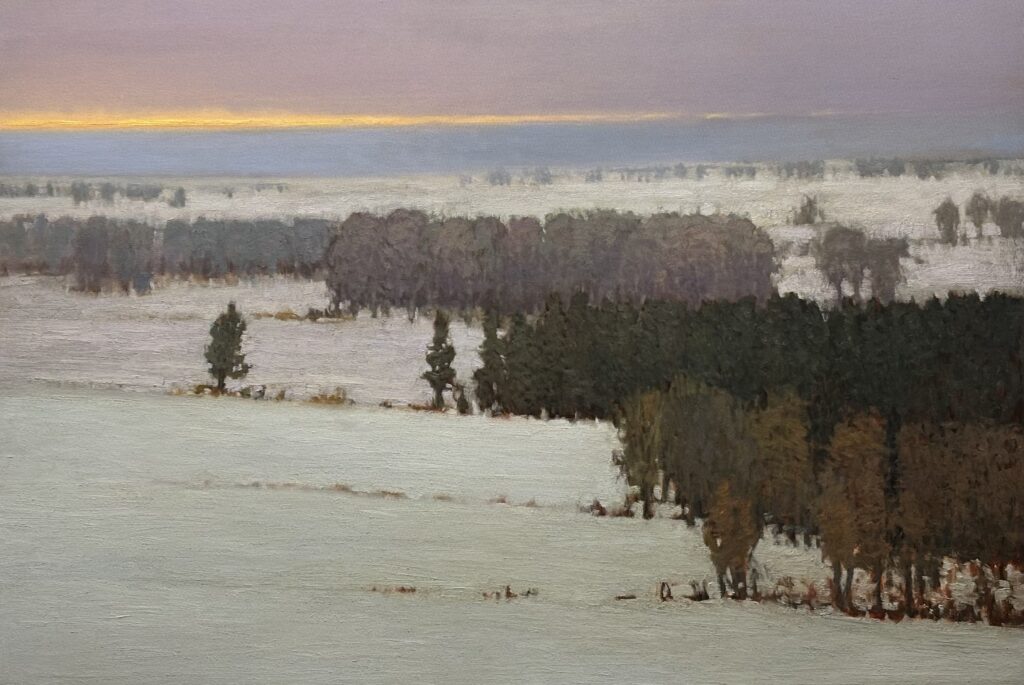
For painter and photographer Peter Campbell, a landscape painting is not an attempt to faithfully reproduce a particular place. Photography may provide the initial reference, but the finished painting emerges through a more intuitive and unpredictable process—one shaped by composition, memory, mood and the possibilities that reveal themselves along the way.
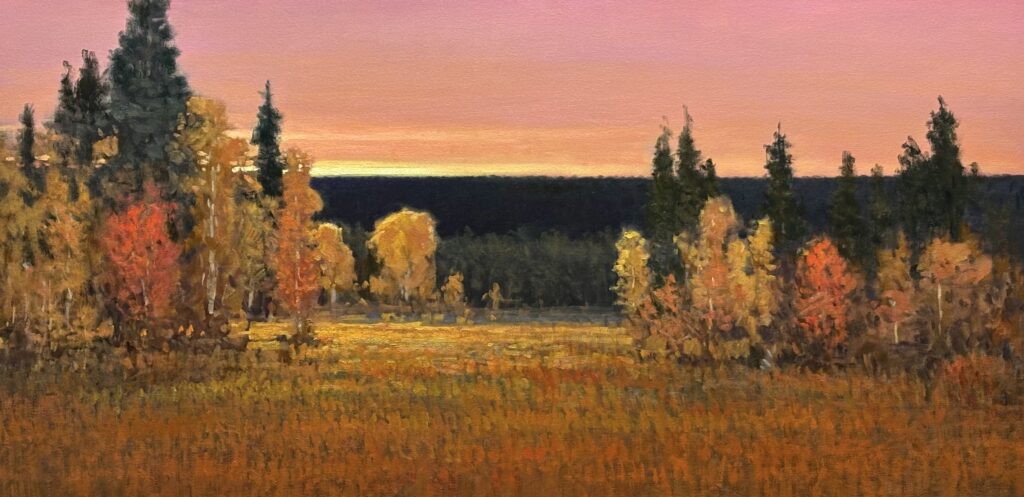
Campbell’s work is currently featured in Impressions at Ann Korologos Gallery, where six paintings—June, The Edge of Yellowstone, Mares Tails, The Lazy River and Autumn—offer different explorations of landscape, light and reflection.
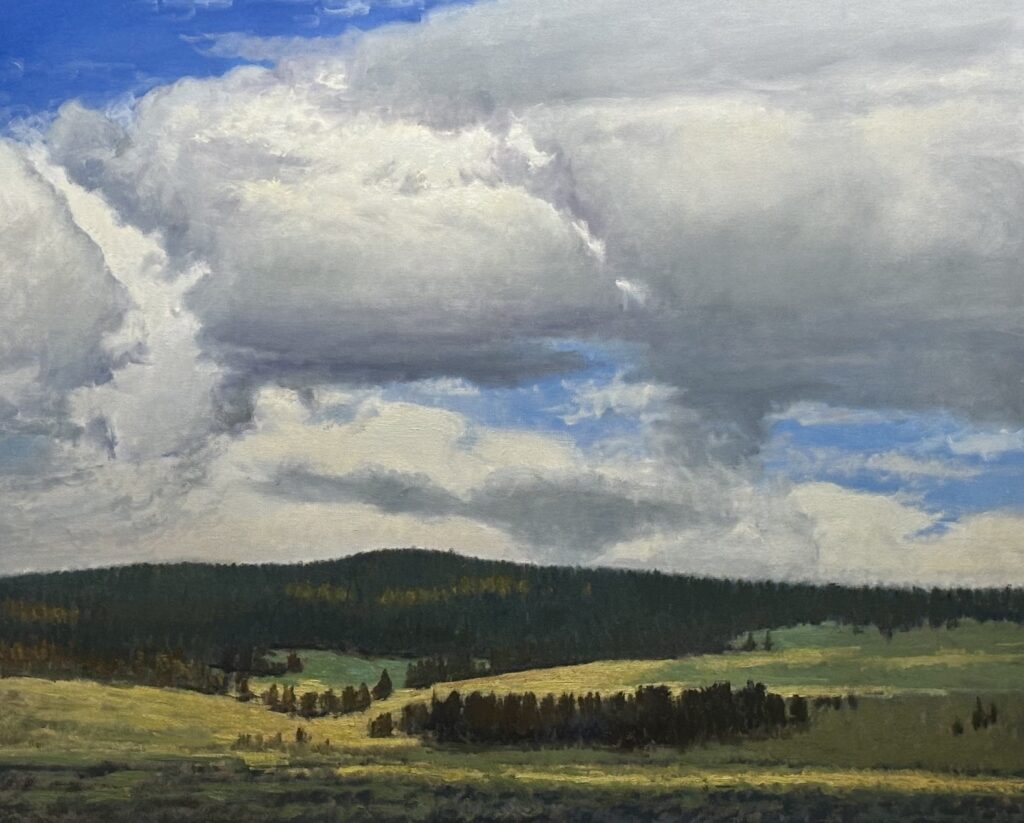
Campbell describes photography as a kind of sketchbook. Although his paintings are often inspired by specific places, he is not interested in creating replicas of either a photograph or an actual location.
“Every painting gets distilled through my own vision and the mood of what I am after,” he says. “That mood sometimes changes in the middle of a work, and I have changed horses mid-stream many times.”
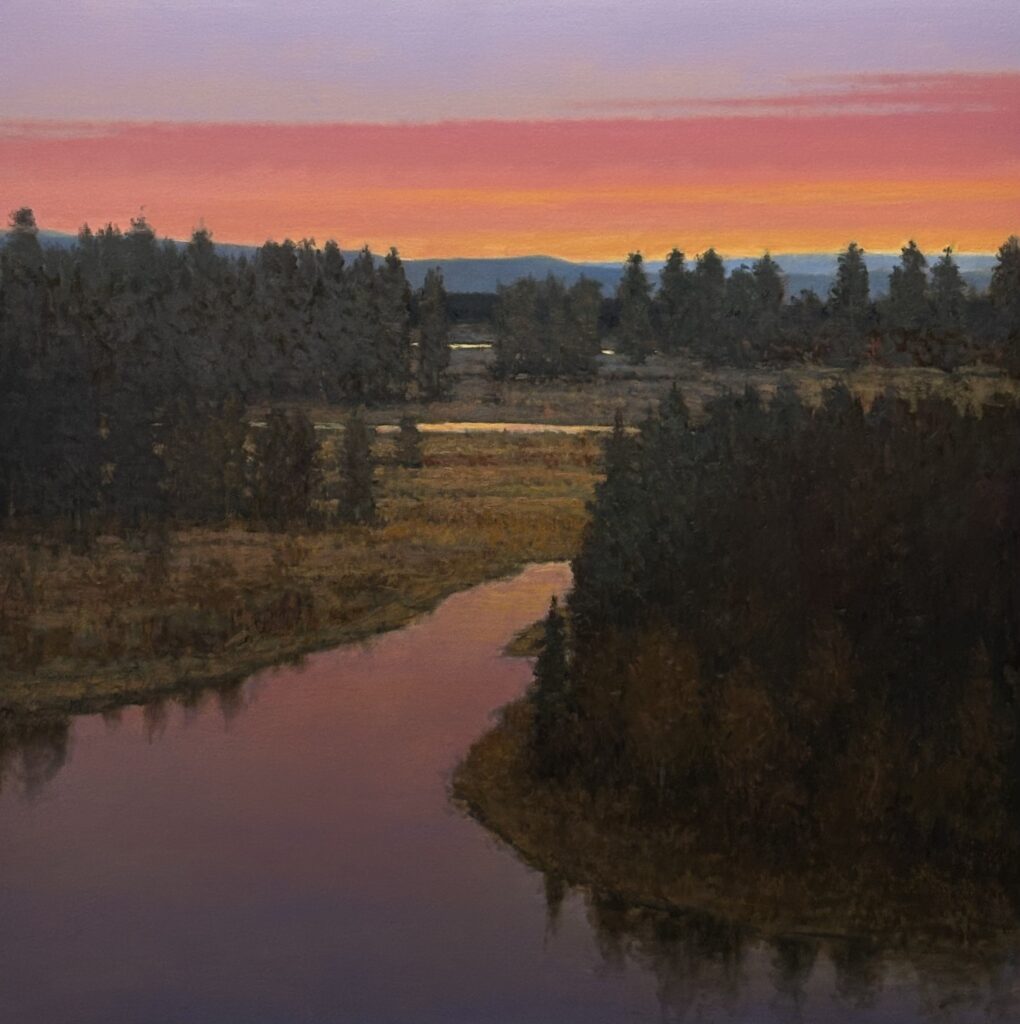
Some paintings may sit for years before he understands where they are going. The Edge of Yellowstone, for example, was inspired by a trip to the South Entrance near Jackson, Wyoming, nearly two decades ago. Campbell had photographs from the trip and knew there was a painting somewhere within them, but he could never quite work it out. When he eventually returned to those images, he began working with only part of the original composition, rearranging elements to recover what had initially inspired him.
“Once I had the form down, everything else just starts to come to me while I work,” he says. “It is rarely a straight point-to-point process.”
The result may bear little resemblance to the actual location. “If I drove you to the location, you might not recognize the scene,” Campbell says, “but the feel of the place would resonate.”
His photographic background has had a lasting influence, particularly when it comes to composition. “I see the world through rectangles and squares,” he says. “Sketches always start with a box to put the image in. What shape is this going to be? That is the first decision.”
For Campbell, the boundaries of the frame are not restrictive so much as liberating. “That boundary starts the whole process because limitation is actually the best way to get started with anything. Too many options invites procrastination and indecision.”
Once the composition is established, he allows himself considerable freedom to make changes—even significant ones—while the shape of the picture provides a structure that holds everything together.
His years as a film photographer also taught him to recognize the limitations of the photographic image itself. “Painting to me is a more honest representation of the world,” he says.
Rather than attempting to capture exactly what was there, Campbell is interested in what the landscape might become through the process of painting. “I don’t cling to what ‘is’—I reach for what could be.”
Water and reflection are recurring elements in Campbell’s landscapes, but his interest goes beyond their visual appeal. He is drawn to the particular stillness and mystery that water can introduce into a painting.
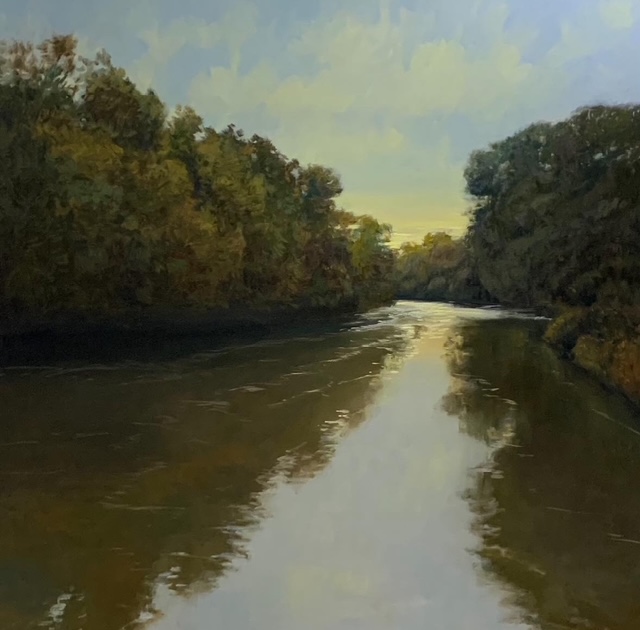
“Painting water and reflections is one of the more exciting phenomena,” he says. “Water draws us in, especially with subtle reflections.”
A convincing reflection requires calm water, and that stillness creates an immediate sense of tranquility. But beneath the reflected surface is another world entirely.
“Something about the surface of water being nature’s mirror, and yet you know there is depth beneath that, conveys some kind of mystery,” Campbell says. “That’s the way I see it.”
In The Edge of Yellowstone, The Lazy River and Call of the River, water and reflection become more than details within the landscape. They help shape the atmosphere of each work, inviting the viewer to look closely at the boundary between what is reflected on the surface and what lies beneath it.
For Campbell, there is no fixed formula for arriving at a finished painting. His process has been shaped by years of experimentation and thousands of paintings, but that experience has ultimately given him more freedom rather than greater certainty.
“Painting is such an unpredictable process if you let it be and can go with it,” he says. “I really don’t have any repeating formula that I rely on other than years of experimenting with thousands of paintings. That kind of experience grants you the freedom to just paint.”
That freedom also means accepting that a painting may change direction, stall or take considerably longer than expected. Campbell has had works sit unfinished for two years or more before he understood what they wanted to become.
“The painting will tell you where it wants to go, and that is part of the fun and, on occasion, the exasperation,” he says.
Ultimately, he sees the process itself as a continuum rather than a search for perfection. “There aren’t any mistakes,” he says. “There is just the process that takes you to the end of a piece and allows you to start another.”
And perhaps that is why the next painting is always the most compelling one.
“Every painter’s favorite piece is the one they haven’t made yet.”